Will I be free of glasses?
It depends on your eye and on the lens. With a monofocal lens you will see well in the distance and wear glasses to read. An extended depth of focus lens adds computer distance. With a trifocal, most people manage without glasses for nearly the whole day.
No lens gives everything. The ones that free you most from glasses are also the ones that cause most halos at night. That is why I would rather you saw it before choosing.
Drag the divider to compare vision with a cataract and with each type of lens, by day and by night. It is an approximate simulation: your result depends on your eye.
Which lens for which life
I do not pick the lens from a catalogue. We choose it together, based on what you do every day and what your eye allows.
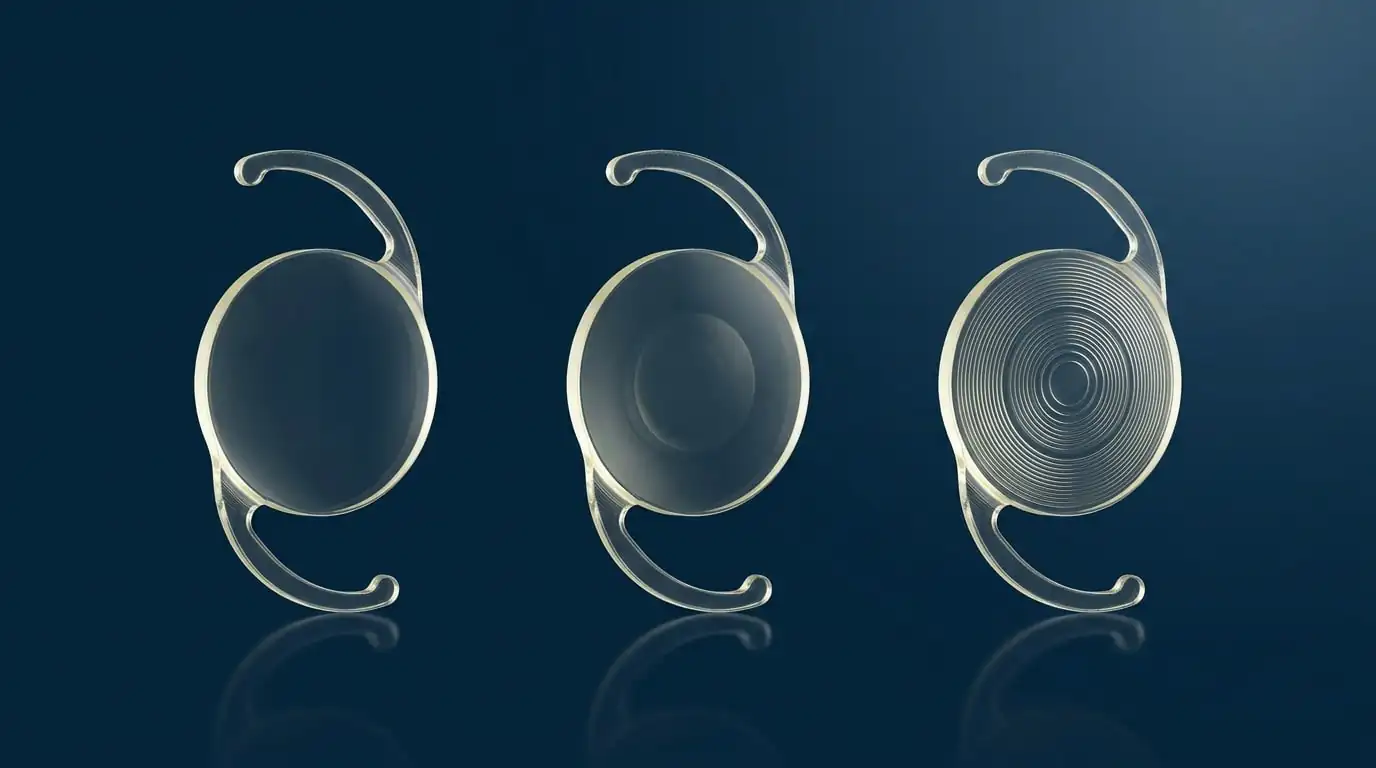
- Monofocal
- Extended focus
- Trifocal
You drive a lot at night
You want the sharpest image and the fewest reflections. A monofocal, or an extended depth of focus lens if you want to see the dashboard and your phone without glasses.
You spend the day in front of a screen
An extended depth of focus lens covers distance to computer with few halos. For small print you may still use glasses now and then.
You want to read, cook and go out without glasses
A trifocal comes closest. In exchange you will see halos around lights at night, which nearly everyone stops noticing over the months.
You have astigmatism
Any of the above comes in a toric version, which corrects it in the same operation. If it is left uncorrected, you will still need glasses with the best of lenses.
You do not mind wearing glasses
Then a monofocal is an excellent option, and there is no need to complicate it.
To go deeper, I have written a guide to toric, extended depth of focus and multifocal lenses, with what the studies say about each one. The cataract guide also covers monovision.
Why it helps to have a retinal surgeon operate
I operate on cataracts and I operate on the retina. For you, as a cataract patient, that changes three things.
- I check the retina before suggesting a lens. A trifocal lens splits the light, and a macula that is not healthy pays for it. With OCT I know before surgery, not after.
- If you are short-sighted, I check the periphery too. Short-sighted eyes have a higher risk of retinal tears, and it is better to treat them before the cataract.
- The serious complications of this surgery are retinal. They are uncommon, but when they happen it is retinal surgeons who deal with them. That is what I do.
And if, besides the cataract, you have a retinal problem that needs surgery, both can be done in the same operation.
How it works
1. The visit
I examine the whole eye with the pupil dilated. I measure the eye with the IOLMaster 700 biometer, which calculates the lens power without touching you, and take an OCT scan of the macula. Then we talk about which distances you use most and how much glasses matter to you. You leave with a specific recommendation and the reasons for it.
2. The operation
Anaesthetic drops, an incision of about 2 mm and no stitches. I break up the lens with ultrasound, remove it and place the folded implant. You go home the same day. One eye is operated on at a time.
3. The check-ups
I see you myself at the check-ups. You will use drops for a few weeks, and if any glasses are needed they are prescribed once the eye is stable, between one and four weeks later.
Cost and insurance
I work with most Spanish health insurers. Toric, extended depth of focus and trifocal lenses carry an extra cost over a monofocal lens, which depends on the lens.
I go through it with you at the first visit, once I know which lens is reasonable for your eye and before you decide anything.
No obligation
Coming for an assessment does not commit you to surgery, or to a premium lens. If a monofocal will serve you well, I will tell you.
Common questions
Does it hurt?
No. With the anaesthetic drops you feel no pain. If you are nervous, a mild sedative can be added.
Do I have to wait for the cataract to ripen?
No. Waiting until it is very hard gains nothing and makes surgery more difficult. It is operated on when it gets in the way of your life.
Am I too old?
Age is not a barrier. Over 80, results are usually as good as in younger people.
The risks and the warning signs after surgery are in the cataract guide.
Want to know what other patients say?
The reviews are on Google, in full, and I do not choose which ones are shown. Read the reviews on Google.
Want to know which lens suits you?
Call and tell us it is for a cataract assessment. At the visit we measure the eye, check the retina and talk about what you want to see without glasses.